

Description
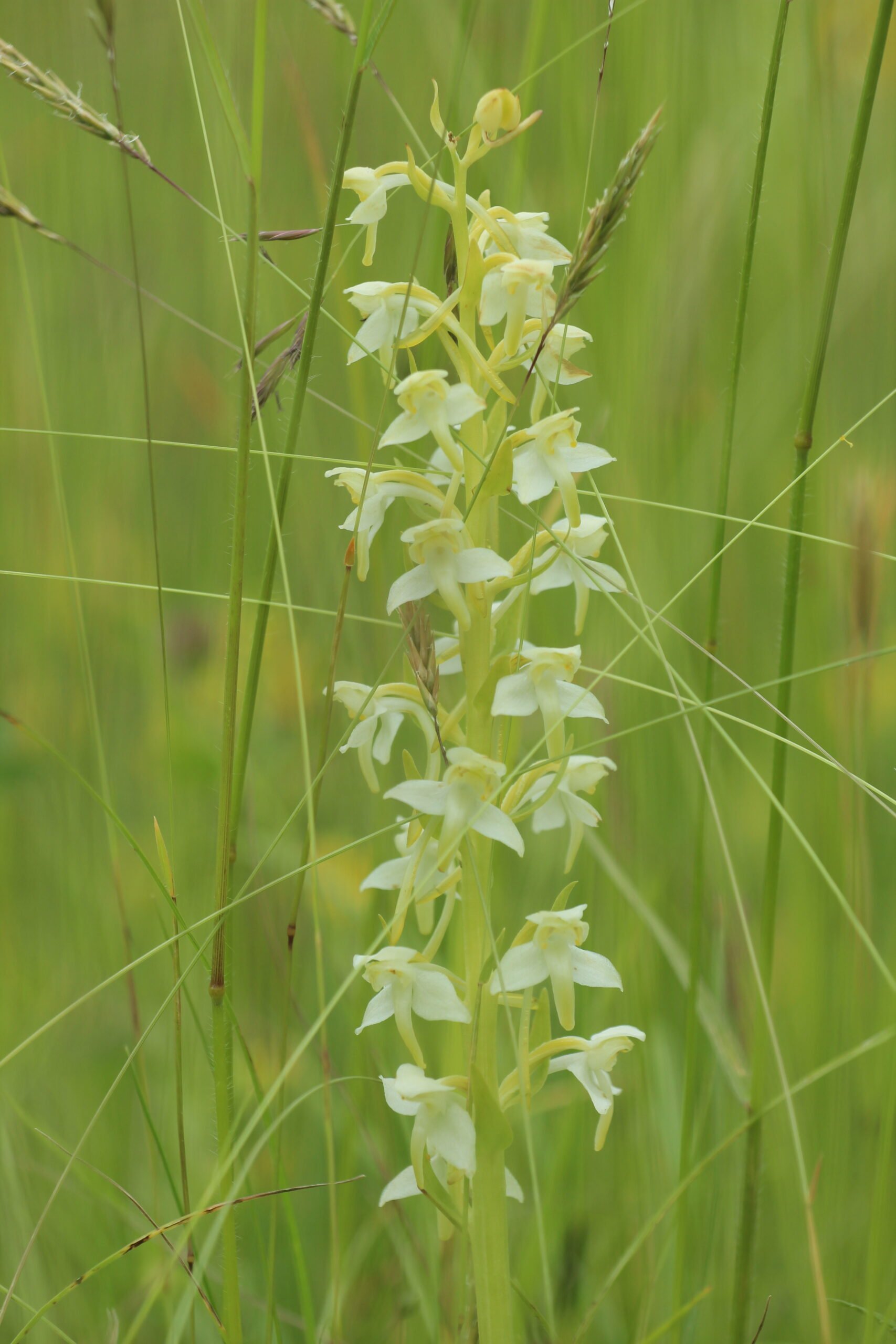
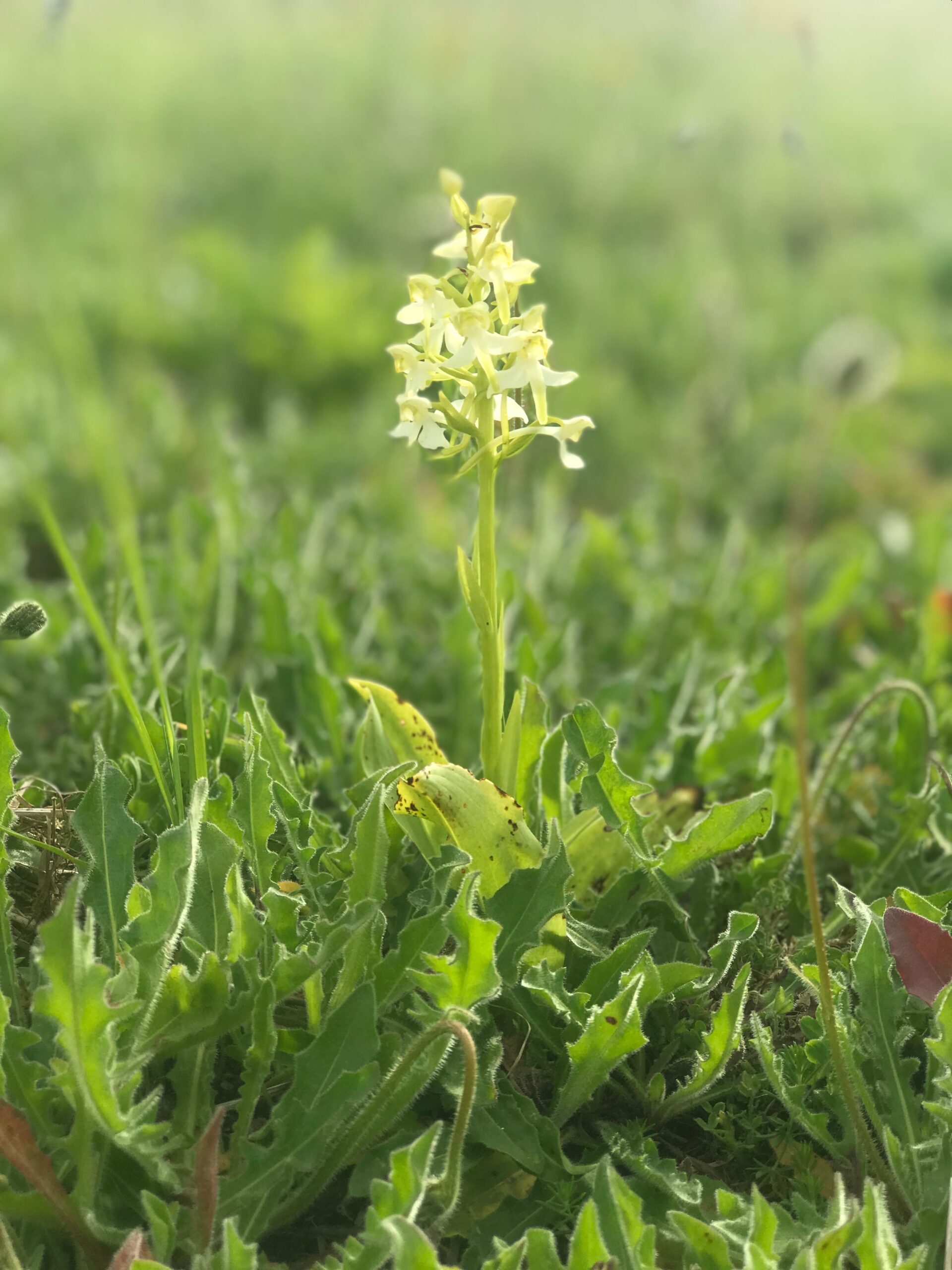
If you come across a tall, graceful orchid with pale, spurred flowers and two large ovate leaves at the base of its stem, you’ve likely found one of Britain’s two native Butterfly-orchids. In deciduous woodland, the Greater Butterfly-orchid is usually the taller species, while in open grassland—especially at higher altitudes—distinguishing it from the Lesser Butterfly-orchid can be more challenging.
Lesser Butterfly-orchids tend to have shinier upper leaf surfaces and whiter flowers, whereas the Greater Butterfly-orchid’s blooms are greenish-white, reflected in its Latin name chlorantha, meaning “green-flowered.” Their scents also differ: the Lesser Butterfly-orchid has a sweet, floral fragrance, but the Greater emits a stronger, vanilla-like aroma.
The most reliable way to tell them apart is by examining the pollinia (pollen sacs). In the Lesser Butterfly-orchid, they are close and parallel, forming an “II” shape. In contrast, the Greater Butterfly-orchid’s pollinia are widely spaced and angled, creating an inverted “V.”
Habitat Information
The Greater Butterfly-orchid has been in slow decline for decades due to intensive agriculture, yet it still occurs across the UK on well-drained calcareous soils. In southern England, it thrives in ash and rowan woodlands—especially those managed by coppicing—and on chalk downland. In northern and western regions, it is more commonly found in lowland meadows.
Its pale flowers, strong night scent, and long nectar spurs suggest that long-tongued moths are the primary pollinators. Observations confirm frequent visits from Geometrid, Noctuid, and Hawkmoths, though which species successfully transfer pollen remains uncertain. Interestingly, the two Butterfly-orchids likely attract different moth species: in the Lesser, pollinia attach to the moth’s proboscis, while in the Greater, they stick to the eyes.
Growing Information
Like many orchids, the Greater Butterfly-orchid relies on a symbiotic fungus for germination and establishment. For this species, fungi from the family Ceratobasidiaceae are particularly important—fortunately it is very common and widespread and will almost certainly be in your soil..
To grow from seed, sow in autumn or early spring on a well-scarified surface or bare soil, ideally alongside meadow sowing. Germination can be unpredictable, but successful plants should appear within three to four years. Alternatively, seeds can be germinated on nutrient media; detailed instructions are available on the Hardy Orchid Society’s website.
Seed Content
NB: SEED SUPPLIED WITH SOIL GRANULES. Pure Orchid seed is extremely fine dust-like with an estimated million seeds per gram! It is tricky to handle and liable to blow away in the wind. For this reason the seed we offer has been combined with soil granules to aid handling and dispersal to the ground.
The orchid seed offered here is sold as a mix of soil granules and seed. Each gram you purchase below is made up of 1 part seed to 99 parts soil granules by weight, and will contain an estimated 10,000 orchid seeds.
Both the cost and seed numbers per gram reflect the number and value of seeds contained in each gram ordered.