


Our wild flower meadows are the jewels in the crown of our home at Manor Farm, but they are just one part of the rich tapestry of wildlife habitats on the farm. Our hedgerows are equally important, forming the latticework of shrubs, trees and taller vegetation that knit all of our meadow habitats together. Over the years we’ve planted hedges to help restore old boundaries and strengthen the wildlife corridors that frame the grasslands. And this winter we’re excited to introduce a new technique to the farm to help manage our hedges – the ancient art of hedgelaying.
Hedgelaying is a traditional form of management that rejuvenates hedges once they become old and ‘gappy’, helping to maintain stock-proof boundaries. Long before the invention of wire fences, hedgelaying was practised widely on farms across the country as a way of maintaining natural barriers and keeping livestock contained in fields. With the introduction of modern wire fencing in the early 20th century and the arrival of hedge-cutting machinery, the practice fell out of favour. In recent years, however, this lost art has enjoyed a revival as more people have begun to appreciate both the benefits and the aesthetic appeal of a well-laid hedge.
This winter we have started to lay a hedgerow on the farm that we planted 20 years ago. Laying a planted hedgerow is particularly useful, as it encourages single-stemmed plants to rejuvenate with multiple stems and thicken up the base of the hedge – the most important part for wildlife.
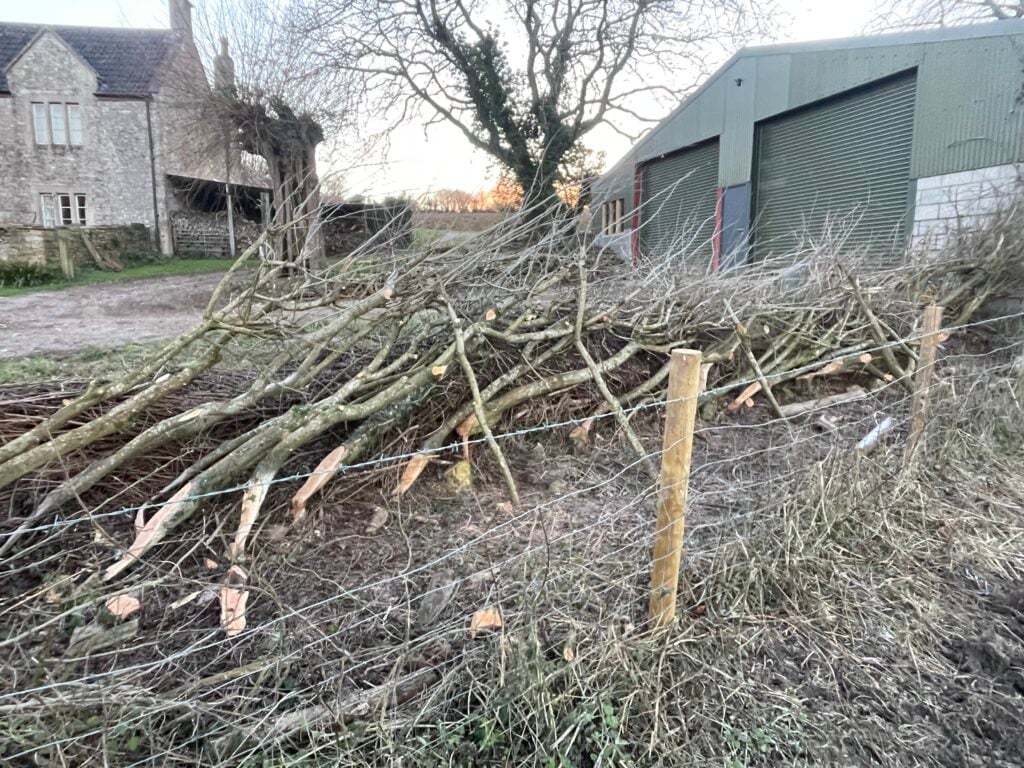
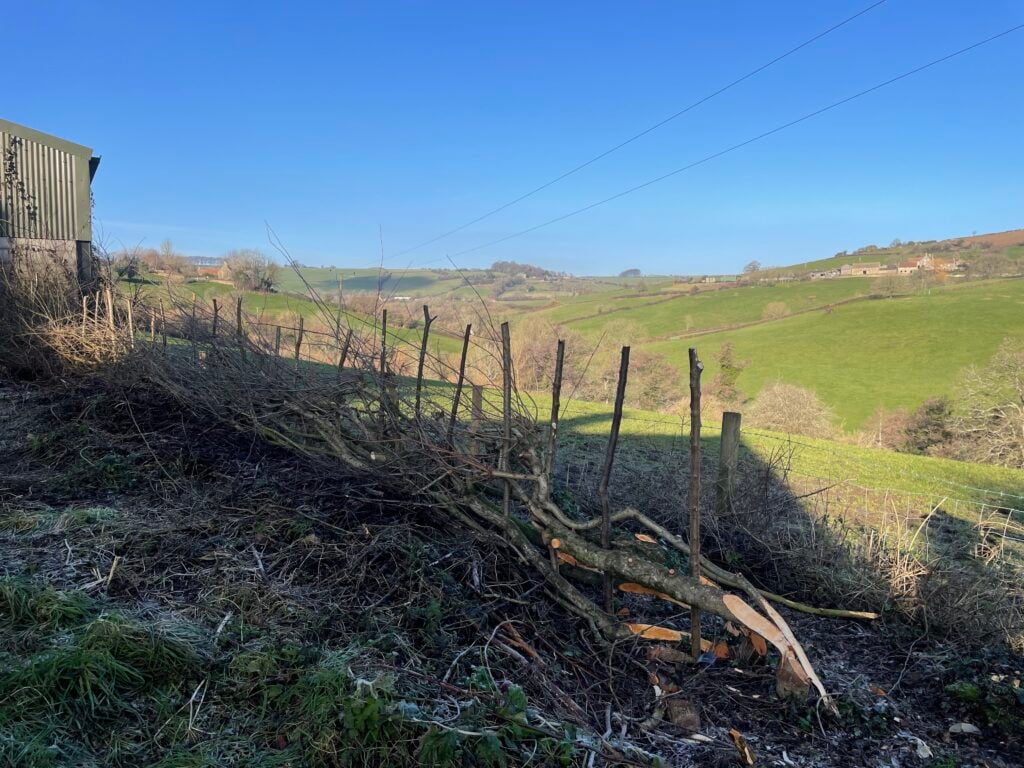
Working one by one through each hedge plant, the first step is to select the branches that will be best suited for laying and remove the unwanted growth that would be too bulky to bend down. The next stage is to make a downward cut (using a billhook or chainsaw) at about 45 degrees near the base of the stem, cutting through most of the wood but leaving a ‘tongue’ or ‘hinge’. This hinge allows the stem to be bent down without breaking – something that can be quite tricky to judge and varies from species to species. Hazel and young hawthorn work well, while field maple and spindle can be more brittle and have less ‘give’. One by one the stems are laid to rest upon one another to form a hedge about waist height.
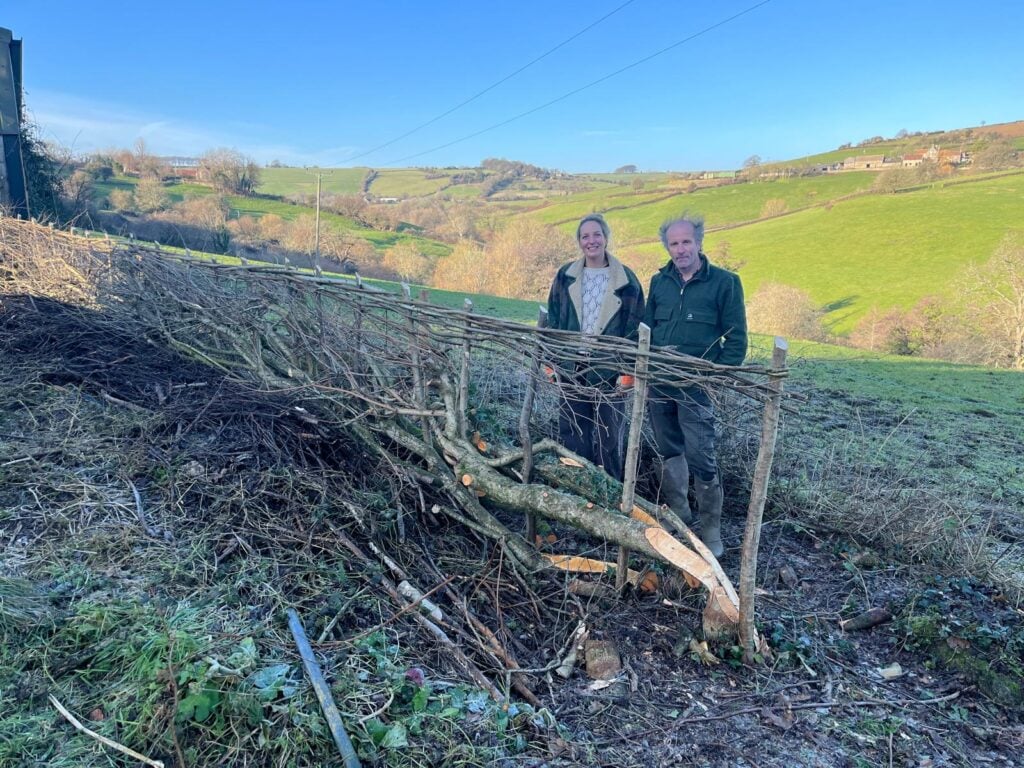
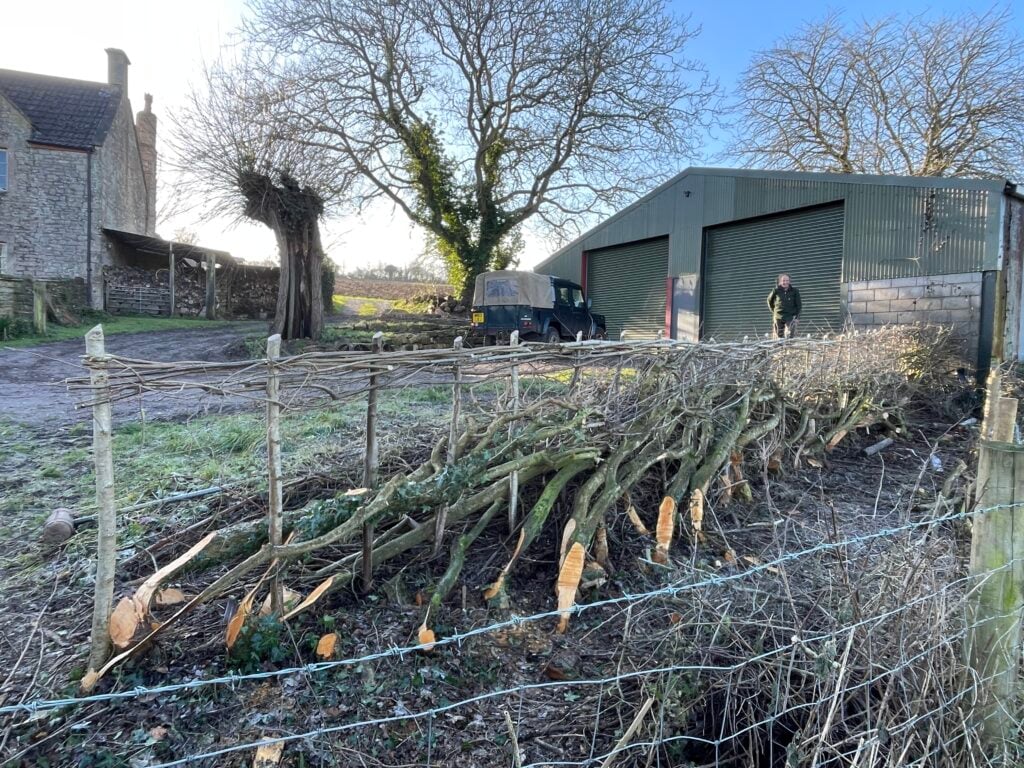
Once a section has been laid, the next stage is to place straight (ish) wooden stakes – either cut from unwanted hedge material or gathered from nearby woodland – into the middle of the hedge, spaced about 18 inches apart. Then comes the most rewarding part: securing the stakes and hedge with a weave or ‘platt’ of long, straight lengths of hazel or willow to form a neat finish along the top. This holds the laid stems securely in place and, over time, the stakes and weave will be lost within the hedge as regrowth from the cut stems grows up to form a dense, thick base.
This year’s hedge will be the start of a programme of hedgelaying that we’ll undertake each winter on the farm. Keep an eye out next winter as we’ll be advertising some hedgelaying training days with our team.