




Search Results: A-guide-to-selecting-species

Leontodon hispidus - Rough Hawkbit

Yellow dandelion-type flowers can be difficult to tell apart, a situation not helped by three of the genera having common names that start with hawk, namely, hawkweeds, hawksbeards and hawkbits. Except for some very rare species hawkbits, dandelions and catsears can be distinguished from the rest by the absence of leaves along the flowering stem. Dandelions contain a milky juice, catsears have chaffy scales among their florets and hawkbits have neither. Rough hawkbit is a short, grassland perennial with a very hairy stem that swells slightly at the top. The solitary flowers, which are in bloom from late May to October, are a rich golden yellow with the outer florets often reddish or orange and the bracts behind the flower appearing very shaggy. The leaves which make up the basal rosette are long and bluntly lobed.

Leucanthemum vulgare - Oxeye Daisy

Ox-eye daisy is a familiar and attractive grassland perennial and our largest native member of the daisy family. It has a medium tall un-branched stem topped by a solitary composite flower of white rays (petals) surrounding a yellow disc floret. Once you become familiar with them the basal leaves of Ox-eye daisy are quite distinctive with their toothed spoon shape and long leaf stalks. Flowers from May to September. Ox-eye daisy is also known as moon daisy or dog daisy and its old botanical name was Chrysanthemum leucanthemum.

Lotus corniculatus - Birdsfoot Trefoil

The common name of this familiar plant is a useful guide to its identification. Birdsfoot refers to the radiating seed pods that are said to look like bird’s feet whilst trefoil describes the leaf which is divided into three leaflets. Its other name of Eggs and Bacon is also descriptive as the mature flower is usually the colour of egg yolk whilst the bud is often red. Birdsfoot trefoil can be distinguished from the other common Lotus, Greater birdsfoot trefoil, in having a smaller stature, lighter green foliage and a solid stem.

Silene flos-cuculi - (Lychnis flos-cuculi) - Ragged Robin

It is difficult to mistake this medium to tall perennial with raggedy red petals for any other common British plant. In flower from May to July. NB Until recently this species was know by the old botanical name of Lychnis flos-cuculi.

Matricaria chamomilla - (Matricaria recutita) - Scented Mayweed

Scented mayweed is a daisy-like annual with finely divided leaves and an aromatic smell when crushed. It is superficially like Corn chamomile but is hairless with more finely divided leaves. A fuller account of the differences can be found in the description of Corn chamomile. NB Until recently this species was know by the old botanical name of Matricaria chamomilla.

Medicago lupulina - Black Medick

Black medick is a short, often sprawling plant with a compact head of bright yellow flowers and clover-like leaves. It can be distinguished from lesser and hop trefoil by its seed pods which are black and coiled when ripe and not buried within the dead flowers, and from other common medicks by the absence of spines on the pods. Flowers from April to July.

Mentha aquatica - Water Mint

Unmistakably a mint from its general appearance and smell, Water mint can be distinguished from other members of the genus by its relatively large size and its whorls of close set flowers forming a rounded head at the top of the stem. An attractive plant with a pleasant smell, its lilac coloured flowers are in bloom from July to late September. Flowers are pollinated by a range of insects, particularly honey and solitary bees.

Oenanthe pimpinelloides - Corky-fruited Water-dropwort

Members of the carrot family can be difficult to identify when first encountered. Corky-fruited water-dropwort is hairless, the leaves are 2 to 3 times pinnate with the upper ones consisting of narrow linear leaflets. The stem is solid, ridged, un-spotted and up to 1m high and the umbel of white or pink flowers has stout rays and is flat topped when in fruit. Flowering occurs from June to August.

Origanum vulgare - Wild Marjoram

Wild marjoram is a British native perennial growing to about 60cm. The dark purple buds at the top of the stem open to show purple, pink or occasionally white bunches of thyme like flowers. The leaves are long, oval and usually slightly toothed and are sweetly scented. Our native plant is the same species as the Mediterranean herb known as oregano but because it grows in a cooler climate it has a less intense and less earthy smell.

Plantago lanceolata - Ribwort Plantain

A short rosette-forming herb with leathery ribbed leaves sprouting from the base of the plant. In grazed or mown turf, and over winter, the leaves are rounded and flattened to the ground, but in meadows and taller grassland the leaves grow upwards and are elongated in shape (lanceolate). Stubby brown flower heads with whitish anthers are borne on plain unbranched and leafless stalks. Flower stalks are produced throughout the summer.

Primula elatior - Oxlip

This attractive woodland perennial can be described as looking like a large cowslip with primrose flowers. Oxlip is most likely to be confused with the commoner and more widespread false oxlip (Primula x polyantha) but this plant tends to have a shorter stem and deeper coloured flowers. The most important difference between the two is the way the flowers are arranged on the top of the stem. Unlike the false oxlip in the true oxlip the umbel drops to one side (see the second image down on the right). Flowers from April to late May.

Primula veris - Cowslip

A very familiar spring flower with a rosette of wrinkled, toothed leaves from which arises one or more flowering stems. The flowers, which are deep yellow with an orange base, are arranged in an umbel that often droops to one side. Flowering occurs throughout April and May. The seed develops in fruit hidden by the sepals and takes an unusually long time to ripen, not being shed until July. Cowslip can be confused with False oxlip and the much rarer Oxlip but their flowers are paler, larger and more spreading (see photos of Oxlip).

Pulicaria dysenterica - Common Fleabane

Common fleabane is an attractive, native and perennial member of the daisy family. It is a distinctly downy, almost woolly plant that grows to about 1m and has lanceolate wavy edged leaves. The rays and disc florets which make up the 3cm diameter flower heads are golden yellow with the flowers blooming from July to late September.

Ranunculus acris - Meadow Buttercup

The tallest and most elegant of our common buttercups, this plant sometimes reaches a height of 90cm. It is distinguishable from the ubiquitous Creeping buttercup by its lower leaves. In both plants the leaves are deeply cut into lobes (normally five in Meadow buttercup and three in Creeping buttercup) but in Creeping buttercup the middle lobes are stalked. The other common buttercup, Bulbous buttercup, is different from both these species in having down-turned sepals (see photograph for Bulbous buttercup). Flowering occurs from April to October.

Rumex hydrolapathum - Water Dock

Water dock is a stately, native perennial reaching a height of almost 2m and with root leaves up to 1m long.

Poterium sanguisorba - (Sanguisorba minor) - Salad Burnet

A short to medium height grassland perennial with greyish pinnate leaves and a rounded flower head of small green flowers with bright red styles (see main photograph). The leaves smell and taste pleasantly of cucumber. NB Until recently this species was know by the old botanical name of Sanguisorba minor.

Scabiosa columbaria - Small Scabious

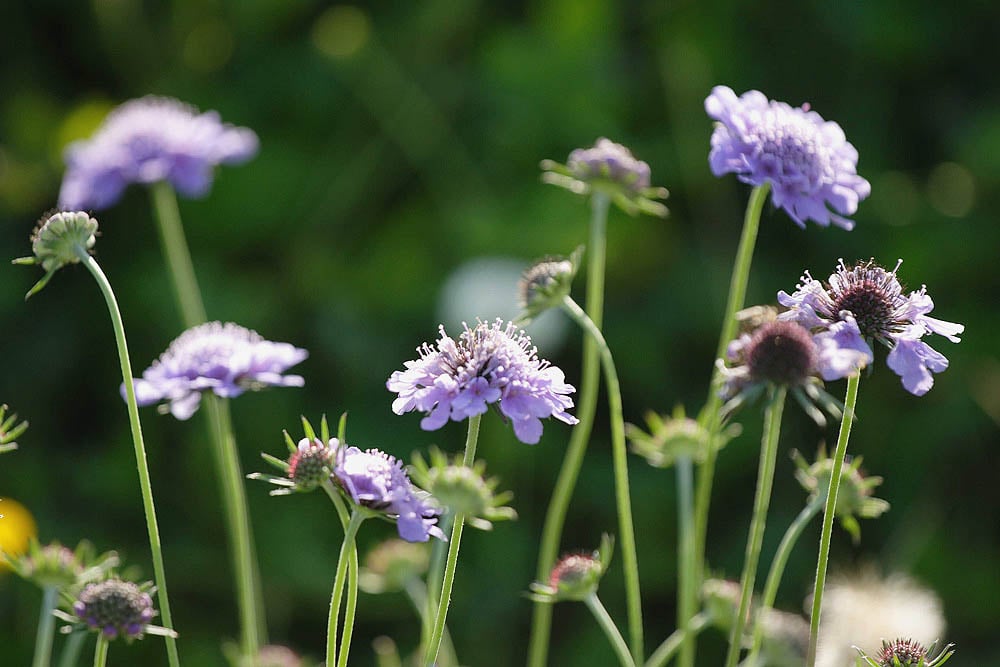
Small scabious is an attractive native perennial growing to 70cm and with a large, pale blue flower head. It can be confused with Field scabious but it is shorter, more slender and less hairy. Also the individual flowers that make up the flower head have five not four petal-lobes. Small scabious flowers from June to October.

Scrophularia auriculata - Water Figwort

Water figwort is a tall, native perennial with an obviously winged, square stem, opposite leaves and a characteristically shaped red brown flower.

Silaum silaus - Pepper Saxifrage

Neither a member of the saxifrages or peppery to taste pepper-saxifrage is a member of the carrot family. Its yellow flowers are arranged in umbels 20-60mm across and its lower leaves are much divided into narrow leaflets.

Silene dioica - Red Campion

An attractive medium to tall perennial with a downy stem and opposite paired leaves. The flowers, which are rose pink, consist of five cleft petals joined at their base to form a tube which is surrounded by a purple brown calyx. Red campion is dioecious, a botanical term that means the male and female flowers are carried on separate plants, hence the species name dioica. The peak of flowering starts as bluebells fade but flowers can be found from March to November with a few remaining throughout the winter.

Page 2 of 8
1 2 3 4 5 6 7 8